

As a supplier of carbon steel motor shafts with thread and step, I've been deeply involved in understanding the intricacies of these components. One of the most critical aspects that often comes up in discussions with clients is the notch sensitivity of these shafts. In this blog, I'll delve into what notch sensitivity means for carbon steel motor shafts with thread and step, its implications, and how it can impact the performance and reliability of these essential parts.
Understanding Notch Sensitivity
Notch sensitivity refers to the degree to which a material's strength and fatigue life are affected by the presence of notches, such as grooves, holes, or sharp corners. In the context of a carbon steel motor shaft with thread and step, notches can occur at the threads, the steps, or any other areas where there is a sudden change in cross - section.
When a load is applied to a shaft, stress concentrations occur at these notches. The stress at the notch can be significantly higher than the average stress in the rest of the shaft. This is due to the geometric discontinuity, which disrupts the smooth flow of stress through the material. The notch sensitivity factor (q) is used to quantify this effect. It is defined as the ratio of the increase in stress concentration factor (Kf) due to the notch to the theoretical stress concentration factor (Kt).
Mathematically, (q=\frac{K_f - 1}{K_t - 1})
where (K_f) is the fatigue stress concentration factor and (K_t) is the theoretical stress concentration factor. A high notch sensitivity factor indicates that the material is more sensitive to notches, meaning that a small notch can have a large impact on the shaft's fatigue life.
Factors Affecting Notch Sensitivity in Carbon Steel Motor Shafts
Material Properties
Carbon steel is a widely used material for motor shafts due to its good strength, ductility, and machinability. However, the notch sensitivity of carbon steel can vary depending on its composition and heat treatment. For example, high - carbon steels generally have higher notch sensitivity compared to low - carbon steels. This is because high - carbon steels are harder and more brittle, making them more susceptible to crack initiation at notches.
Heat treatment processes such as quenching and tempering can also affect notch sensitivity. Quenching can increase the hardness of the steel but may also introduce residual stresses, which can exacerbate the effect of notches. Tempering, on the other hand, can relieve these residual stresses and improve the ductility of the steel, reducing its notch sensitivity.
Notch Geometry
The shape and size of the notch play a crucial role in determining the notch sensitivity. Sharp notches, such as those with a small radius at the root of the thread or step, can cause a higher stress concentration compared to rounded notches. The depth and width of the notch also affect the stress distribution. Deeper and wider notches generally result in higher stress concentrations and greater notch sensitivity.
Loading Conditions
The type of loading, whether it is static or dynamic, also influences notch sensitivity. In static loading, the stress at the notch may cause plastic deformation, which can redistribute the stress and reduce the impact of the notch. However, in dynamic loading, such as cyclic loading in a motor shaft, the repeated stress cycles can cause crack initiation and propagation at the notch, leading to fatigue failure.
Implications of Notch Sensitivity for Carbon Steel Motor Shafts
Fatigue Life
Notch sensitivity has a significant impact on the fatigue life of carbon steel motor shafts. A shaft with high notch sensitivity is more likely to fail due to fatigue under cyclic loading. The stress concentrations at the notches can cause micro - cracks to form, which then grow over time until the shaft fails. This can lead to unexpected breakdowns in the motor, resulting in costly downtime and repairs.
Performance and Reliability
The presence of notches can also affect the overall performance and reliability of the motor shaft. Higher stress concentrations can cause the shaft to deform more easily, leading to misalignment and reduced efficiency. In extreme cases, the shaft may even break, causing the motor to stop working.
Mitigating Notch Sensitivity
Design Optimization
One of the most effective ways to mitigate notch sensitivity is through design optimization. This involves using rounded notches instead of sharp ones, reducing the depth and width of the notches, and ensuring a smooth transition between different cross - sections. For example, using a larger fillet radius at the root of the thread or step can significantly reduce the stress concentration.
Material Selection and Heat Treatment
Choosing the right material and heat treatment process can also help reduce notch sensitivity. As mentioned earlier, low - carbon steels generally have lower notch sensitivity compared to high - carbon steels. Additionally, proper heat treatment can improve the ductility of the steel and relieve residual stresses, reducing the impact of notches.
Surface Treatment
Surface treatments such as shot peening can also be used to improve the fatigue resistance of the shaft. Shot peening introduces compressive stresses on the surface of the shaft, which can counteract the tensile stresses caused by the notches. This can help prevent crack initiation and propagation, increasing the fatigue life of the shaft.
Our Offerings as a Supplier
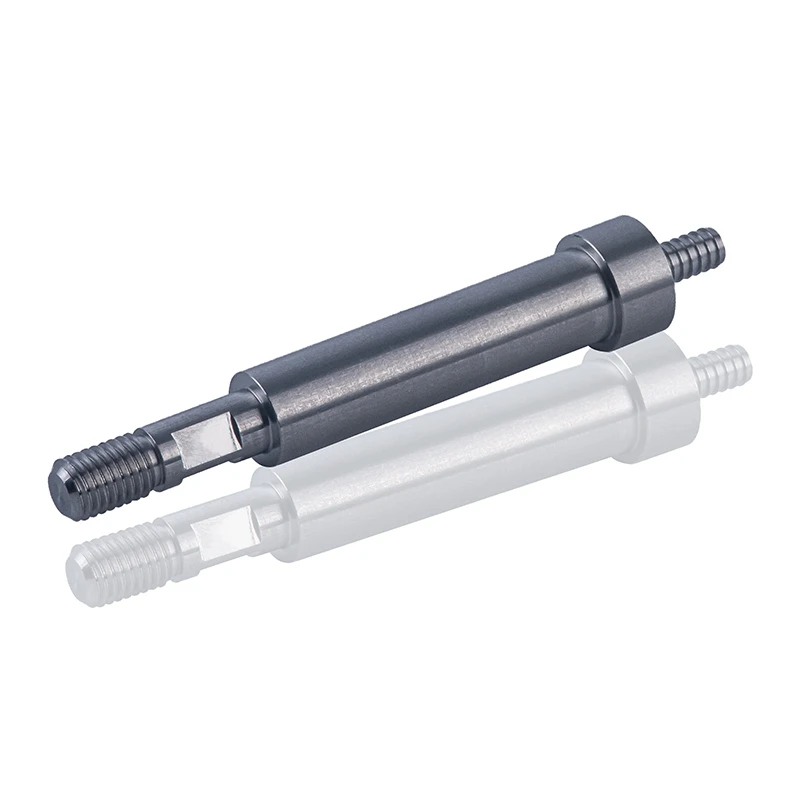
At our company, we understand the importance of notch sensitivity in carbon steel motor shafts with thread and step. We offer a wide range of Carbon Steel Motor Shaft with Thread and Step that are designed and manufactured to minimize notch sensitivity.
Our shafts are made from high - quality carbon steel, and we use advanced heat treatment processes to ensure optimal material properties. We also pay close attention to the design of the shafts, using rounded notches and smooth transitions to reduce stress concentrations. Additionally, we offer surface treatment options such as shot peening to further improve the fatigue resistance of our shafts.
If you are in the market for carbon steel motor shafts with thread and step, we invite you to contact us for a discussion. Our team of experts can help you select the right shaft for your specific application and provide you with detailed information about our products and services. We are committed to providing high - quality products and excellent customer service, and we look forward to working with you.
References
- Dowling, N. E. (2012). Mechanical Behavior of Materials: Engineering Methods for Deformation, Fracture, and Fatigue. Pearson.
- Shigley, J. E., & Mischke, C. R. (2003). Mechanical Engineering Design. McGraw - Hill.